
E-bikes seem to be everywhere. Drive through neighborhoods around Cedar Park, Leander, Northwest Austin, or other growing Austin-area communities and you may see kids and teenagers riding electric bikes to school, visiting friends, heading to parks, or simply cruising around the neighborhood. For parents of middle school students, that creates an interesting question: Is an e-bike actually a good way for a middle school child to get to school? There isn’t a simple yes-or-no answer. E-bikes can give older children independence, make longer trips easier, and reduce the need for parents to drive everywhere. But they are also faster and heavier than traditional bicycles, and those differences can turn ordinary childhood riding mistakes into much more serious situations. Before buying an e-bike for a middle school student, parents should consider the child’s age, maturity, riding ability, route to school, traffic conditions, school policies and—perhaps most importantly—the speed and type of e-bike. Quick Takeaways for Parents E-bikes can provide transportation and independence for some older children. Knowing how to ride a regular bicycle does not automatically mean a child is ready for an e-bike. Speed is one of the biggest differences between traditional bicycles and e-bikes. The American Academy of Pediatrics recommends that children under 12 not operate e-bikes. For ages 12–15, current pediatric guidance says parents who determine their child is ready should consider only a Class 1 e-bike. Parents should practice the complete school route with their child before allowing independent commuting. Helmets, visibility, traffic knowledge and responsible decision-making should be non-negotiable. Local school and city rules should always be checked. For Leander ISD families, the district has specific safety expectations for students bringing e-bikes and similar devices to school. An e-bike can be useful transportation, but it shouldn’t automatically replace walking, traditional biking and other forms of physical activity.
Are E-Bikes Good for Middle School Kids? Pros, Cons & Safety Tips for Austin-Area Parents
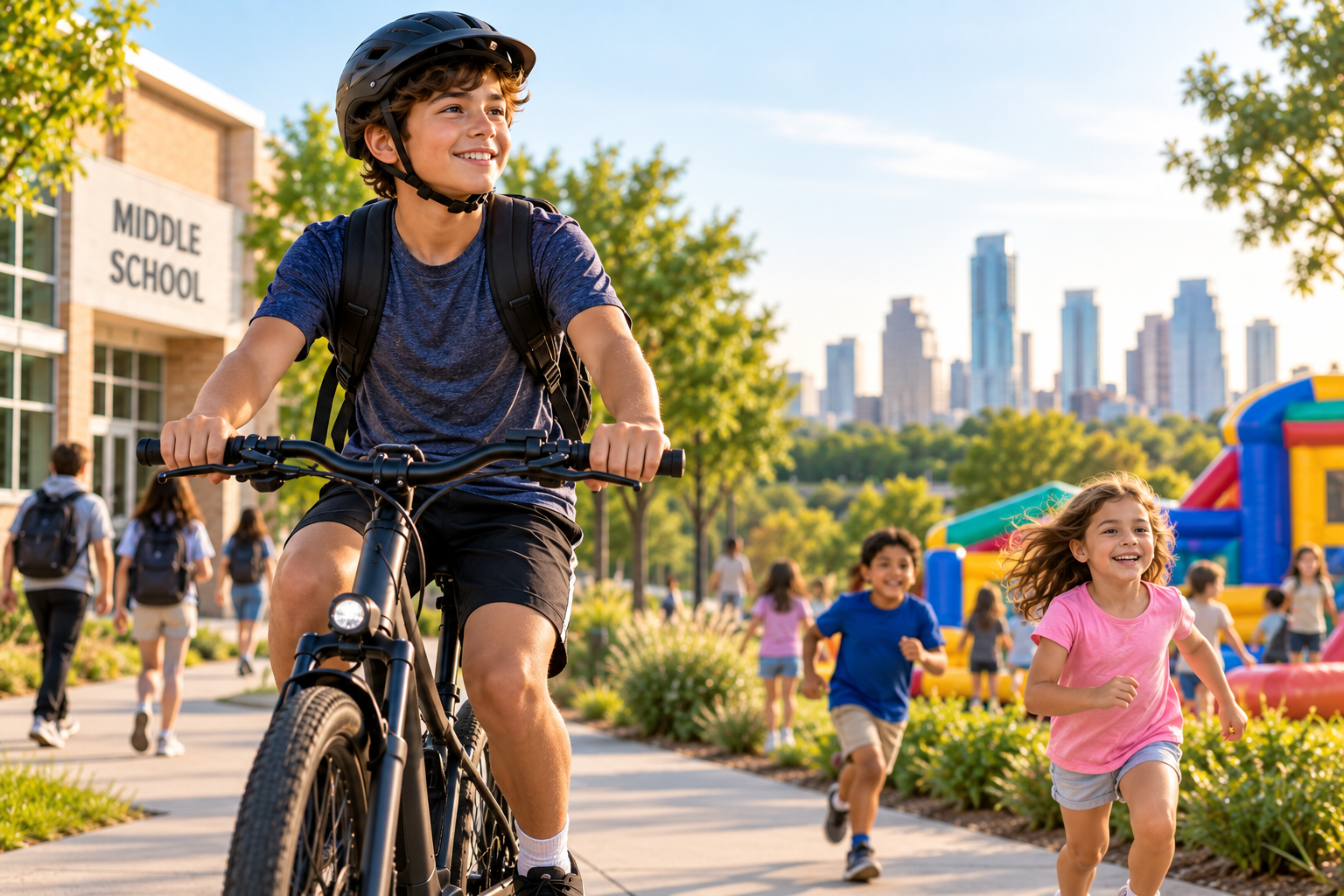
Why Are E-Bikes Becoming So Popular With Kids?
The attraction is easy to understand.
A regular bicycle requires the rider to provide all of the power. An e-bike adds an electric motor and battery that assists the rider.
That can make hills easier and longer distances more manageable.
For a middle school student who lives a few miles from school, an e-bike can potentially turn a trip that feels too far on a traditional bicycle into a manageable commute.
It can also offer something many middle school students desperately want:
independence.
Instead of asking:
“Can you drive me?”
a child may be able to travel to school, a friend’s house or another nearby destination independently.
For busy parents, that independence can sound wonderful.
But independence needs to grow alongside responsibility.
Not All E-Bikes Are the Same
One of the first things parents should understand is that “e-bike” describes several different types of bicycles.
Generally, e-bikes are divided into three classes.
Class 1 E-Bikes
The motor assists while the rider pedals and assistance generally stops at 20 mph.
Class 2 E-Bikes
These can provide motor assistance through a throttle and can generally reach up to 20 mph without requiring continuous pedaling.
Class 3 E-Bikes
These are faster and can provide assistance at speeds up to approximately 28 mph.
That difference matters tremendously when the rider is a child.
Twenty-eight miles per hour might not sound extremely fast when you’re sitting inside a car.
On a bicycle, however, it is significant speed.
Parents shouldn’t simply ask:
“Should I buy my child an e-bike?”
A better question is:
“What type of e-bike, at what speed, for what child, riding on what route?”
Those details completely change the decision.
What Do Pediatric Safety Experts Say About Kids and E-Bikes?
The American Academy of Pediatrics urges families to use significant caution with children riding e-bikes.
Its current guidance notes that e-bikes are faster, heavier and more difficult to manage than traditional bicycles.
The guidance recommends that children under age 12 should not operate e-bikes. For children ages 12–15 whose parents determine they are ready, the recommendation is to use only a Class 1 e-bike.
That age range is especially important because it overlaps directly with middle school.
It also highlights something parents sometimes overlook:
Being physically capable of riding an e-bike isn’t the same as being developmentally ready to manage one around traffic.
The Pros of E-Bikes for Middle School Students
1. They Can Build Independence
Middle school is often when children begin wanting more freedom.
Riding independently to school can teach responsibility, time management and navigation.
Instead of depending on a parent for every short trip, an older child may gradually learn to manage appropriate transportation independently.
2. They Can Make Longer School Commutes Practical
A traditional bicycle may be reasonable for one child but unrealistic for another who lives farther from school.
Electric assistance can make longer distances and hills easier.
That could make biking practical for families who otherwise would need to drive.
3. They May Reduce Some Parent Drop-Off and Pickup Trips
School mornings can be hectic.
Parents are getting ready for work, preparing younger children, packing lunches and coordinating multiple schedules.
For an appropriately aged and prepared student with a safe route, independent transportation can simplify the morning.
4. Kids Still Spend Time Outdoors
An e-bike still gets a child outside instead of sitting inside a vehicle.
They experience their neighborhood differently and learn how streets, intersections and routes connect.
5. It Can Teach Transportation Responsibility
Used properly, an e-bike creates opportunities to teach children about helmets, traffic laws, maintenance, route planning, pedestrians, visibility and responsible decision-making.
Those are useful lessons before they eventually become drivers.
The Cons and Risks Parents Should Consider
The advantages sound appealing.
The risks deserve equal attention.
1. E-Bikes Can Be Much Faster Than Parents Realize
Speed changes everything.
At higher speeds, children have less time to recognize a hazard, make a decision and stop.
A driveway.
A reversing vehicle.
A pedestrian.
A dog.
A pothole.
A wet patch of pavement.
A car turning unexpectedly.
Situations that are manageable at slower speeds can become much more difficult when a child is moving quickly.
2. E-Bikes Are Heavier
The motor and battery add weight.
That can make an e-bike harder for a smaller rider to maneuver, balance, stop or control after something unexpected happens.
Parents should make sure their child can comfortably handle the actual bicycle rather than choosing one primarily because of speed, appearance or popularity.
3. Traffic Judgment Is a Bigger Issue Than Riding Ability
Many middle school students can ride bicycles extremely well.
That doesn’t necessarily mean they can interpret traffic well.
Consider situations such as:
Who has the right of way?
Is that driver actually stopping?
Is the car about to turn?
Can the driver see me?
Should I pass this pedestrian?
Is it safe to enter this intersection?
Those decisions require judgment—not just balance.
4. Friends Can Change Behavior
A child may ride responsibly when a parent is watching.
Then three friends appear.
Suddenly someone wants to race.
Someone wants to ride faster.
Someone wants a passenger.
Someone says:
“Watch this!”
Parents should consider how their child behaves around friends, not only how the child behaves during a supervised test ride.
5. Distractions Are Dangerous
Phones, texting, music and headphones can reduce awareness.
On an e-bike, things happen quickly.
A child needs to hear vehicles, notice pedestrians, watch driveways and constantly monitor the road.
6. Battery Safety Matters
E-bikes use rechargeable lithium-ion batteries.
Parents should follow manufacturer charging instructions, use the appropriate charger and pay attention to damaged or modified batteries.
The Consumer Product Safety Commission advises consumers to use micromobility devices and batteries designed and certified to applicable safety standards and to follow manufacturer instructions.
Parents should treat the battery as an important piece of safety equipment—not simply something children plug in wherever they find an outlet.
What About Riding an E-Bike to Middle School in Cedar Park or Leander?
This is particularly relevant for local families.
Leander ISD has published safety guidance regarding students bringing e-bikes, scooters and similar devices to school.
The district tells students to follow applicable laws and district safety expectations, obey traffic laws, walk e-bikes or scooters on campus except where otherwise designated, park in designated areas and avoid carrying additional passengers on devices intended for one person.
The district also strongly encourages students riding to or from school to maintain speeds of 15 mph or below.
Parents should still check their child’s individual campus policies and current city regulations because requirements can differ by location.
Before Saying Yes, Ride the School Route Together
This may be one of the best tests a parent can perform.
Don’t evaluate the e-bike only in your driveway.
Ride the actual route to school with your child.
Preferably, test it around the same time your child would normally travel.
Look for:
- busy intersections
- school buses
- high-speed roads
- construction
- blind driveways
- difficult crossings
- areas without sidewalks or bike lanes
- heavy school drop-off traffic
- places where cars frequently turn
- sections where visibility is poor
A three-mile ride through quiet neighborhood streets is very different from a three-mile ride requiring several major road crossings.
Distance alone doesn’t determine whether a route is safe or appropriate.
Route complexity matters.
A Simple Parent Readiness Test
Before allowing a middle school student to commute independently on an e-bike, ask yourself:
Can my child ride a traditional bicycle confidently?
Can they brake quickly without losing control?
Do they consistently wear a helmet without arguing about it?
Do they understand stop signs and traffic signals?
Do they know how to yield to pedestrians?
Will they slow down even when friends are riding faster?
Will they leave their phone alone while riding?
Will they avoid headphones or earbuds?
Can they handle an unexpected situation without panicking?
Do they understand that carrying friends can change the handling of the bicycle and may violate rules?
Have we practiced the complete route together?
Would I trust this child to follow these rules when I’m not watching?
That final question may be the most important one.
Create an E-Bike Family Agreement
Parents don’t necessarily have to choose between unlimited freedom and banning e-bikes entirely.
Create boundaries.
For example:
Helmet every ride. No passengers. No phone while moving. No headphones. Follow the approved route. Obey traffic signals. Slow down around pedestrians. No racing. No modifying speed limiters. No riding somewhere without telling a parent.
Consequences should also be clear.
If the rules aren’t followed, e-bike privileges can be temporarily removed.
That makes the e-bike a responsibility rather than simply another toy.
Don’t Forget About Regular Physical Activity
There’s another side to this conversation.
Technology increasingly makes childhood easier.
Cars replace walking.
Screens replace outdoor play.
Electric assistance can replace some of the effort involved in bicycling.
Convenience isn’t necessarily bad.
But children still need opportunities to run, jump, climb, play and move their bodies.
Parents don’t necessarily need to choose between technology and traditional activity.
There can be room for both.
An e-bike might help an appropriately aged child commute somewhere.
A traditional bicycle can still be used.
Walking can still be encouraged.
Sports can remain part of the week.
And children can still have completely unstructured playtime.
Sometimes Kids Still Need to Simply Play
Childhood doesn’t need to become completely optimized.
School.
Homework.
Sports.
Tutoring.
Technology.
Transportation.
Schedules.
Sometimes children simply need somewhere to move around and have fun.
For younger children and families around Cedar Park, Leander, Northwest Austin and the surrounding area, Inflatable Wonderland Austin inside Lakeline Mall provides an indoor place where kids 11 and younger can bounce, climb, slide and play.
It’s a completely different experience from riding an e-bike—and that’s exactly the point.
Children benefit from experiencing different kinds of movement and play.
Some days might involve bicycles outside.
Other days might involve sports.
And sometimes it’s nice to forget about transportation, speed and schedules and simply let kids play.
So, Should a Middle School Student Ride an E-Bike to School?
For some middle school students, possibly—with significant conditions.
For others, not yet.
Age alone shouldn’t make the decision.
Parents should consider:
Age + maturity + riding experience + e-bike class + speed + route + traffic + school rules + safety habits.
A responsible 13-year-old riding an appropriate Class 1 e-bike along a familiar low-traffic route after substantial training presents a very different situation from a child riding a powerful high-speed e-bike across busy intersections with friends.
Parents shouldn’t feel pressured because:
“Everyone at school has one.”
Every child is different.
Every route is different.
And every family’s comfort level is different.
Conclusion: Independence Should Grow With Responsibility
E-bikes aren’t automatically good or bad for middle school students.
They’re tools.
Used appropriately, an e-bike may provide transportation, independence and a new way for an older child to move around the community.
Used irresponsibly—or before a child has developed the necessary judgment—the additional speed and weight can create serious risks.
So don’t make the decision based primarily on whether your child wants one.
Ask whether they’re ready for one.
Practice together.
Start slowly.
Choose an age-appropriate bike.
Set rules.
Require a helmet.
Learn the route.
Check your school and local regulations.
And continue watching how your child handles responsibility as their independence grows.
Childhood is filled with these transitions.
First they play independently.
Then they ride a bicycle.
Eventually they may travel around the neighborhood themselves.
Later comes driving.
Parents don’t have to rush every milestone.
The goal is to give children increasing freedom when their skills and judgment are ready for it.
And when younger kids simply need a place to bounce, climb, slide and burn off some energy, families around Cedar Park, Leander and Northwest Austin can visit Inflatable Wonderland Austin at Lakeline Mall, 11200 Lakeline Mall Drive, Cedar Park, TX 78613.
Frequently Asked Questions
Are e-bikes safe for middle school students?
It depends on the child’s age, maturity, riding ability, type of e-bike and route. The American Academy of Pediatrics recommends no e-bikes for children under 12. For ages 12–15 whose parents determine they are ready, its current guidance recommends starting with a Class 1 e-bike.
What type of e-bike is better for a younger teenager?
Current American Academy of Pediatrics guidance recommends Class 1 for children ages 12–15 who are considered ready to ride. Parents should also check Texas law, local regulations, manufacturer age recommendations and school policies before making a decision.
Should kids wear helmets on e-bikes?
Yes. A properly fitted helmet should be treated as non-negotiable for children riding bicycles or e-bikes.
Should my child ride an e-bike to school?
Consider more than distance. Evaluate traffic, intersections, bike lanes, sidewalks, visibility, the child’s judgment and school policies. Practice the complete route together before considering independent riding.
Is an e-bike better than a regular bicycle for school?
Not necessarily. A traditional bicycle is lighter, slower and provides more physical activity. An e-bike may make a longer commute easier. The better choice depends on the child and the route.
Can Leander ISD students bring e-bikes to school?
Leander ISD’s student guidance addresses students bringing e-bikes and similar devices to school and establishes safety expectations for doing so. Families should verify their individual campus’s current rules before beginning an e-bike commute.
How fast should a child ride an e-bike near school?
Slower is generally safer around campuses, pedestrians, driveways and congested areas. Leander ISD currently strongly encourages students riding to and from school to maintain speeds of 15 mph or below.
What are good alternatives if my middle schooler isn’t ready for an e-bike?
Depending on distance and the neighborhood, families can consider walking with friends, a traditional bicycle, carpooling, school transportation or parent drop-off. There is no reason to rush into an e-bike simply because other students have one.
Where can younger kids enjoy active indoor play near Cedar Park and Leander?
Inflatable Wonderland Austin is located inside Lakeline Mall at 11200 Lakeline Mall Drive in Cedar Park, Texas. The indoor playground serves children 11 and younger and provides inflatables, slides, climbing and other active play options for families around Cedar Park, Leander, Northwest Austin and surrounding communities.