
This list highlights practical, research-backed habits that help parents build strong connections with their children: clear limits, focused listening, and play that teaches emotional skills. Establish clear boundaries – Choose a few age-appropriate, nonnegotiable rules so children know what’s expected and feel safe within predictable limits. Practice active listening – Give your child full attention, make eye contact, and reflect their feelings to open honest conversation and deepen your bond. Encourage play-based learning – Use play to teach social skills and emotional awareness, letting children try out interactions in a low-pressure setting. Model emotional regulation – Show simple coping tools, like slow breathing, so children learn healthy ways to manage big feelings. Prioritize quality time – Carve out short, meaningful moments — shared meals, bedtime stories, or a quick walk — to strengthen connection and communication. Provide constructive feedback – Praise effort and specific actions instead of only results, which builds a growth mindset and resilience. Implement consistent routines – Keep daily schedules predictable to give children stability, reduce anxiety, and help them feel more secure. Engage in family activities – Do fun things together — game nights, crafts, or projects — to create shared joy and lasting bonds.
Essential strategies for positive parenting — key ideas
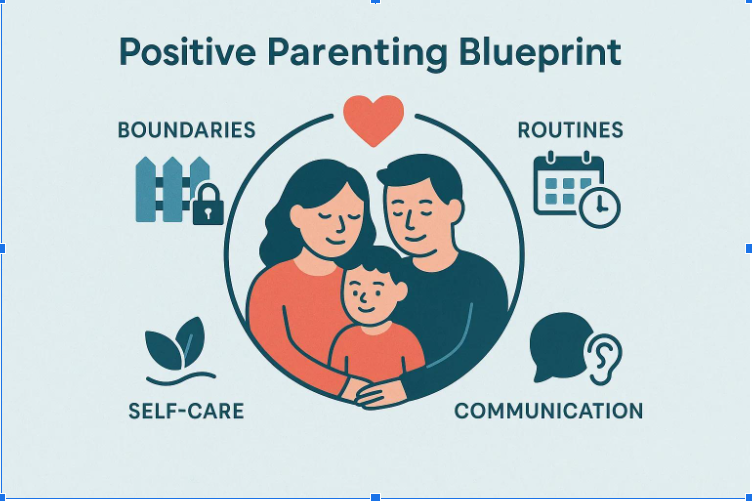
Mastering positive parenting: foundational strategies for thriving families
Positive parenting focuses on teaching, connection, and guidance instead of punishment. When we lead with clear limits, warm attention, and consistent routines, children learn self-control, cooperation, and emotional skills. This guide pulls together practical tools — from positive discipline and play activities to short self-care practices for parents — so families can build stronger relationships and a calmer home. Each section offers clear steps, simple active-listening techniques, playful exercises to grow emotional intelligence, and stress-management tips you can try right away.
Implementing key positive-discipline strategies for healthy child development
Positive discipline gives children structure while teaching life skills. It relies on steady limits, meaningful consequences, and targeted praise instead of punitive tactics. This approach helps children internalize self-control, feel secure, and reduces power struggles. Core practices include setting clear, age-appropriate rules, keeping routines steady, using natural or logical consequences, and rewarding specific positive behaviors to reinforce what you want to see more of.
The essential role of clear boundaries in positive discipline
Clear boundaries matter because they create a predictable space for children to explore. Pick a few nonnegotiable rules, explain why they exist in simple terms, and follow through consistently. When older kids help shape the rules, they’re more likely to follow them. Pair boundaries with positive reinforcement — notice and name the specific actions you want to encourage (like trying hard or taking responsibility) to build intrinsic motivation rather than relying on rewards.
Cultivating strong parent-child relationships with intentional time and better communication
Strong relationships grow from small, regular moments of connection plus thoughtful communication. Active listening — getting down to your child’s eye level, reflecting their feelings, and asking open questions — helps children feel heard and builds their emotional vocabulary. Shared routines like bedtime stories, cooking together, or short walks give repeated chances for attunement, gentle coaching, and modeling social skills, which builds trust and independence over time.
Supporting research:
Building Strong Parent-Child Relationships Through Positive Interaction and Communication
This study shows that open, positive interactions between parents and children are key to developing effective early communication. Using a correlational quantitative method, the research found a significant link between parent–child interaction and communication skills in early childhood.
Desmita, D. (2023). The Relationship of Parent-Child Interaction in Developing Effective Communication in Early Childhood.
Active listening and building emotional connection: practical parenting methods
True active listening means giving full attention, reflecting what your child says, and validating their feelings — steps that lower defensiveness and invite learning. Short daily practices, like two-minute check-ins or a brief “rose and thorn” at bedtime, make this easier to do consistently. Play gives children a low-stakes setting to practice cooperation, negotiation, and empathy; imaginative, cooperative, and physical games teach turn-taking, perspective-taking, and self-control. Screen-free play spaces such as Inflatable Wonderland Austin can add variety and low-effort options for these skills-building moments.
Nurturing parenting: building emotional intelligence and resilience
Nurturing parenting intentionally teaches emotional language, models self-regulation, and offers manageable challenges to grow resilience. Use simple breathing exercises, name feelings out loud, and coach children through social bumps to turn everyday moments into learning opportunities. Give limited, age-appropriate choices and small daily responsibilities to boost independence and self-worth. Celebrate effort and progress with specific praise to encourage a growth mindset that supports resilient problem-solving over time.
Further scholarly insight:
Play-Based Learning: Fostering Emotional Intelligence in Young Children
This review examines how play-based learning supports young children’s emotional intelligence, with a focus on ages 0–5. Neuroscience highlights birth to age 7 as a crucial window for developing foundational skills, making playful, guided interactions especially powerful.
Tyilo, N. (2021). CHILDREN’S EMOTIONAL INTELLIGENCE DURING PLAY-BASED LEARNING PEDAGOGY: A REVIEW OF THE LITERATURE.
Creating a calmer home: parental self-care and joyful family rituals
A peaceful home depends on steady routines, small self-care habits for parents, and regular family activities that reduce stress. Calm adults model emotional regulation and help create safer learning spaces for kids. Try tiny self-care moves — three deep breaths between transitions, delegating tasks, or asking for help — and set simple rituals like a weekly game night or a shared craft to build stability and shared joy that lower reactivity and invite consistent positive interactions.
Practical strategies for parent self-care and stress reduction
Small, repeatable self-care habits — scheduled micro-breaks, leaning on your support network, or brief breathing pauses — protect parents from burnout and pass a sense of calm to children. Prioritizing screen-free family time encourages face-to-face talk, cooperation, and memory-making. Ideas like family game nights, backyard scavenger hunts, or visits to supervised indoor play centers such as Inflatable Wonderland Austin create ready-made shared experiences that spark conversation and model social skills. Regular, screen-free rituals help solidify family identity and reduce stress over the long run.
Frequently asked questions
What are some effective ways to establish clear boundaries with children?
Start with a few simple, age-appropriate nonnegotiables and explain them in plain language so kids understand why they matter. Involve older children in setting rules where possible to increase buy-in. Be consistent: follow through calmly and predictably. Add positive reinforcement by noticing and praising when they follow the rules to encourage repeat behavior.
How can parents effectively practice active listening with their children?
Set aside short, focused moments to listen without distraction. Use eye contact, reflect what your child says, and validate their feelings. Try quick routines like a two-minute check-in or the “rose and thorn” exercise where kids share a high and a low from their day. These small practices build trust and help children feel understood.
What role does play have in fostering emotional intelligence in children?
Play gives children a safe space to try out social roles, practice empathy, and learn cooperation. Through imaginative and cooperative play, kids rehearse negotiation, turn-taking, and emotional responses while getting immediate feedback. Play-based learning strengthens emotional vocabulary and helps children experiment with responses before real-world stakes are higher.
How can parents manage stress to create a harmonious home environment?
Use tiny, regular self-care moments — deep breaths between transitions, short breaks, or asking for help — to lower stress. Keep routines predictable and plan enjoyable family activities like game nights or creative projects. When parents model calm, children feel safer and family interactions become more positive.
What are some strategies for nurturing resilience in children?
Teach emotional words, model steady self-regulation, and offer small challenges that match your child’s age. Praise effort and specific strategies rather than just outcomes to foster a growth mindset. Give limited choices and consistent responsibilities to build independence and confidence over time.
How can parents incorporate quality time into their busy schedules?
Plan short, intentional connections: shared meals, bedtime stories, a quick walk, or a two-minute check-in. Even brief, focused moments can deepen bonds if you’re truly present. Prioritize a few reliable routines and protect that time from distractions to make it count.
Conclusion
When parents use positive parenting tools — clear boundaries, focused listening, play-based learning, and small self-care habits — families tend to feel closer, calmer, and more resilient. Consistent quality time, attention to feelings, and predictable routines create an environment where children grow emotionally and socially.
With supervised indoor play at Inflatable Wonderland Austin, kids can explore, move, and practice social skills while parents model calm and connection. These strategies are practical, evidence-informed, and ready to try; explore more resources and adapt what fits your family to start seeing steady, positive change.