
Blog




What Did My Kid Just Say? A Parent’s Guide to Gen Alpha Slang
If you have an elementary or middle school student, you may occasionally wonder whether children have developed an entirely new language. Words such as “sigma,” “rizz,” “aura,” “cooked,” “skibidi” and “67” can move quickly from online videos and gaming communities into classrooms, playgrounds and family conversations. Although parents often call this “Gen Z slang,” many children using these expressions today are actually Gen Alpha. Their vocabulary is heavily influenced by Gen Z, older siblings, gaming, social media and internet culture. Parents do not need to memorize every new expression. Understanding a few popular terms—and paying attention to how children use them—can provide a useful window into their friendships, humor and online experiences. ... more



How Much Should You Spend on a Gift Card for a Kid’s Birthday Party? An Austin-Area Parent Guide
Birthday parties are an important part of childhood. They give children an opportunity to celebrate friendships, spend time together outside school and create memories that can last much longer than the cake, decorations or presents. For parents, however, receiving another birthday invitation often brings up a practical question that rarely appears on the invitation itself: How much should you spend on a gift card for a kid’s birthday party? For families in Austin, Cedar Park, Leander and surrounding communities, there is no universal amount that is appropriate for every birthday. A child invited to the party of a classmate they have known for a few months is different from a child attending their best friend’s birthday or celebrating a cousin they have grown up with. Family budgets also vary considerably, particularly when households with multiple children may receive several birthday invitations within a short period. Instead of searching for one amount that every parent is expected to spend, it is more useful to develop a comfortable family approach to birthday gifts. The relationship between the children, how frequently your family attends parties and what you can reasonably afford should matter much more than the size or cost of the celebration. ... more
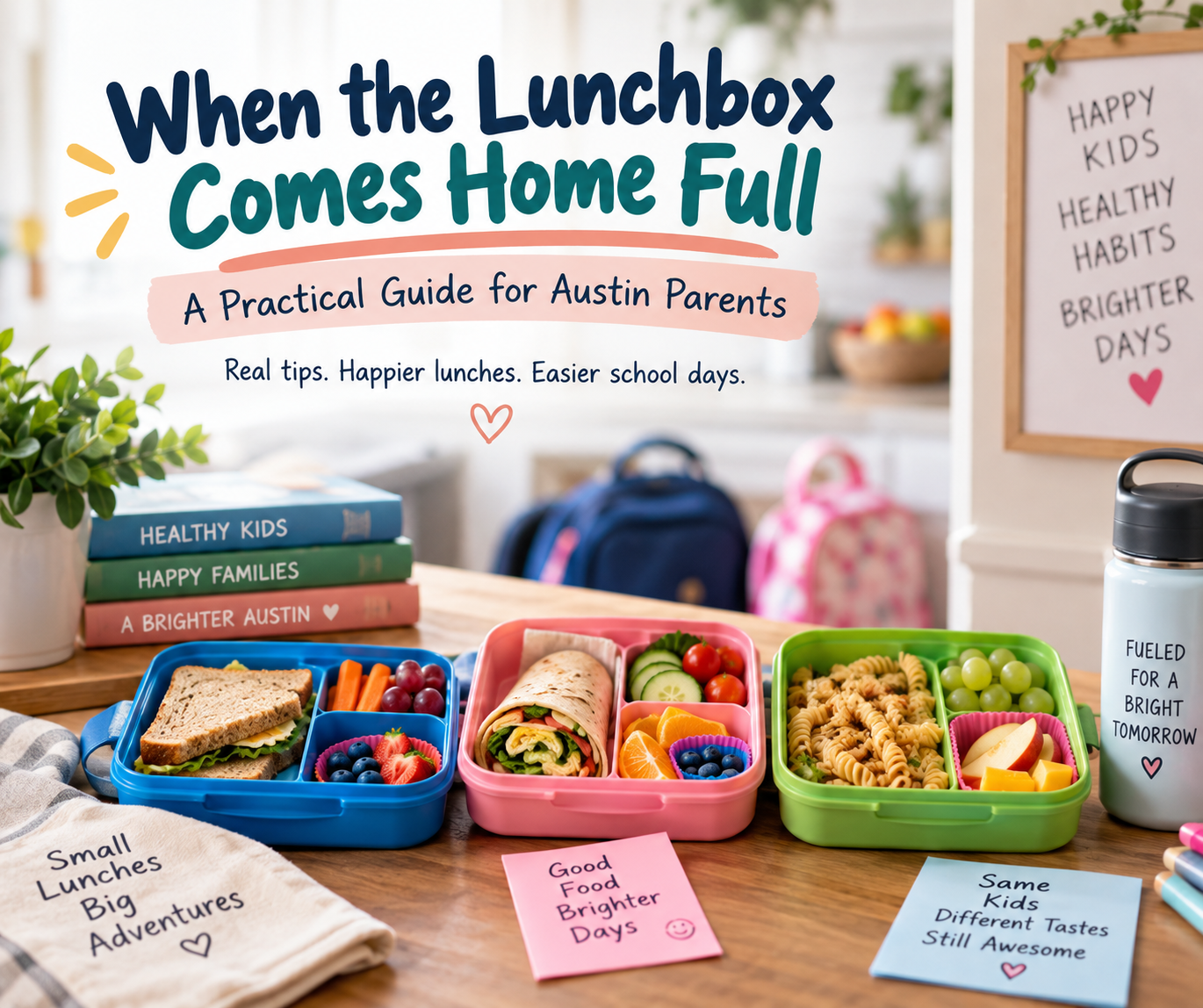
When the Lunchbox Comes Home Full: A Practical Guide for Austin Parents
Packing school lunches sounds like one of the simpler parts of parenting—until you actually have to do it every day. You find something your child likes, pack it for school, and feel relieved when the lunchbox comes home empty. Great. You finally found something that works. So you buy more of it. Then, a few days later, the same child brings the entire lunch back home. Suddenly, the food they loved last week is something they “don’t like anymore.” For families with multiple children, the challenge becomes even more complicated. One child loves pasta but doesn’t want sandwiches. Another loves sandwiches but refuses cheese. One asks for strawberries all week, so you buy a large container—and suddenly strawberries are no longer acceptable. Meanwhile, another child wants whatever their sibling has until you actually pack it for them. The result is wasted food, wasted money and frustrated parents wondering what they’re supposed to pack tomorrow. This is a common school-lunch challenge, and the solution isn’t necessarily finding more recipes. For busy families in Austin, Cedar Park, Leander and surrounding communities, a better approach is to understand why lunches come home uneaten, create a manageable rotation, involve children in reasonable choices and build one lunch system that can work for several different personalities and preferences. The goal isn’t a perfect lunchbox. The goal is a lunch your child is reasonably likely to eat and a morning routine parents can realistically maintain. ... more

Are E-Bikes Good for Middle School Kids? Pros, Cons & Safety Tips for Austin-Area Parents
E-bikes seem to be everywhere. Drive through neighborhoods around Cedar Park, Leander, Northwest Austin, or other growing Austin-area communities and you may see kids and teenagers riding electric bikes to school, visiting friends, heading to parks, or simply cruising around the neighborhood. For parents of middle school students, that creates an interesting question: Is an e-bike actually a good way for a middle school child to get to school? There isn’t a simple yes-or-no answer. E-bikes can give older children independence, make longer trips easier, and reduce the need for parents to drive everywhere. But they are also faster and heavier than traditional bicycles, and those differences can turn ordinary childhood riding mistakes into much more serious situations. Before buying an e-bike for a middle school student, parents should consider the child’s age, maturity, riding ability, route to school, traffic conditions, school policies and—perhaps most importantly—the speed and type of e-bike. Quick Takeaways for Parents E-bikes can provide transportation and independence for some older children. Knowing how to ride a regular bicycle does not automatically mean a child is ready for an e-bike. Speed is one of the biggest differences between traditional bicycles and e-bikes. The American Academy of Pediatrics recommends that children under 12 not operate e-bikes. For ages 12–15, current pediatric guidance says parents who determine their child is ready should consider only a Class 1 e-bike. Parents should practice the complete school route with their child before allowing independent commuting. Helmets, visibility, traffic knowledge and responsible decision-making should be non-negotiable. Local school and city rules should always be checked. For Leander ISD families, the district has specific safety expectations for students bringing e-bikes and similar devices to school. An e-bike can be useful transportation, but it shouldn’t automatically replace walking, traditional biking and other forms of physical activity. ... more

Back Talk vs. Respectful Response: How to Teach a 10-Year-Old the Difference
“Don’t talk back to me!” It is one of those phrases many parents say almost automatically. But when a 10-year-old questions a rule, explains why they disagree, or asks for another chance, are they really talking back? Not necessarily. At age 10, children are becoming more independent. They have stronger opinions, a growing sense of fairness, and an increasing desire to have their parents listen to their point of view. That creates an important parenting challenge: How do you teach a child to respect authority without teaching them that they aren’t allowed to question, disagree, or speak up? The answer is learning to distinguish back talk from respectful responding. The goal is simple: You can disagree with a parent without disrespecting a parent. ... more

How to Plan a Kids’ Birthday Party at Home: Pros, Cons, Costs & Ideas for Parents
A child’s birthday party doesn’t have to take place at a traditional party venue. For many families, hosting a kids’ birthday party at home is an appealing choice. Home provides a familiar environment, complete control over the guest list and menu, and the freedom to create a celebration around what your child actually enjoys. But a home birthday party also means that the responsibilities usually handled by a venue become the parent’s job. You may be responsible for preparing the house, organizing activities, serving food, supervising children, managing the schedule, and cleaning everything afterward. So before deciding where to celebrate, it helps to look at both sides. This guide explains the advantages and disadvantages of hosting a kids’ birthday party at home, how to make a home celebration work, what it can cost, and when a different setting may be a better fit. ... more